
Aleppo soap or
Marseille soap?
You’ve probably wondered what the difference is between Aleppo soap and Marseille soap. When should you use one over the other, or what’s their history? You’ll find all the answers to your questions in this article.
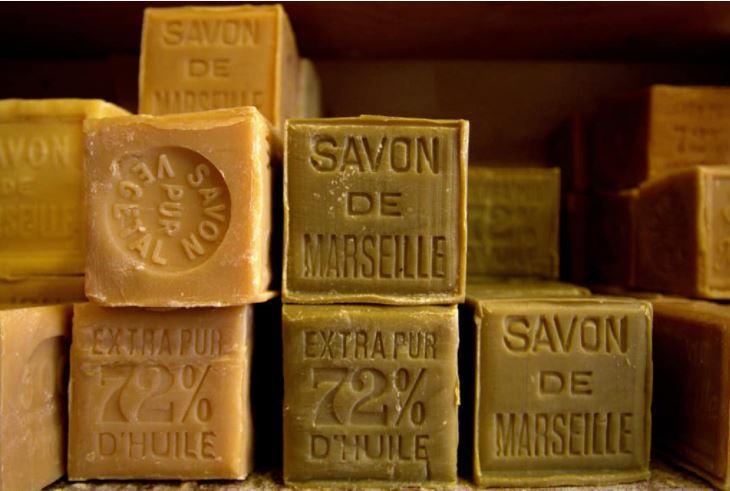
Marseille soap :
A touch of Provençal gentleness
Composition and History
Marseille soap has its roots in Aleppo, Syria. It was during a crusade in the 12th century that the crusader knights brought Aleppo soap back with them. Since Marseille was renowned as a major olive-producing region, it was only natural that the city would become a leading center for soap production. The earliest records of Marseille soap date back to 1370. Its formulation was even regulated by Colbert in 1688.
Marseille soap is made from olive oil and lye. It is, therefore, a very simple product. If you see Marseille soaps on the market with a long list of ingredients, steer clear!
Those ingredients have no place in this product with its minimalist composition. Make sure your soap contains 72% olive oil. As for its color, it ranges from white to green. Marseille soap traditionally comes in 600-gram cubes.
Its benefits and how to use it
Marseille soap can be used for personal hygiene: body, face, and even hair. You can also use it for household cleaning. Whether for washing dishes or doing laundry, Marseille soap is known for its antibacterial properties. There are other, more unusual uses for Marseille soap, such as brushing your teeth. Surprising, isn’t it?
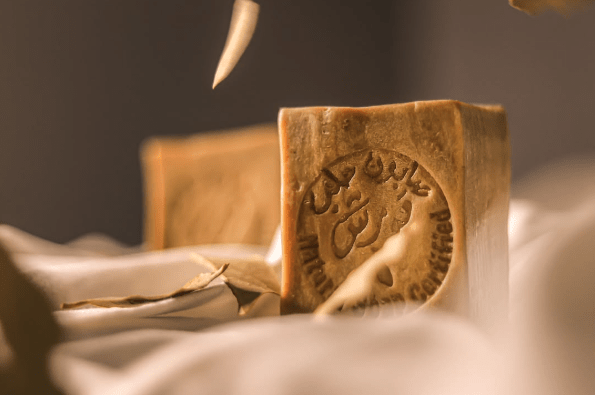
Aleppo soap :
A treasure from the East
Composition and History
Before we talk about history, let’s talk a little about geography. The city of Aleppo is located in northwestern Syria. It is renowned as a major commercial hub. The first Aleppo soaps appeared over 3,500 years ago. It was the Crusaders who introduced them to Europe during the Middle Ages.
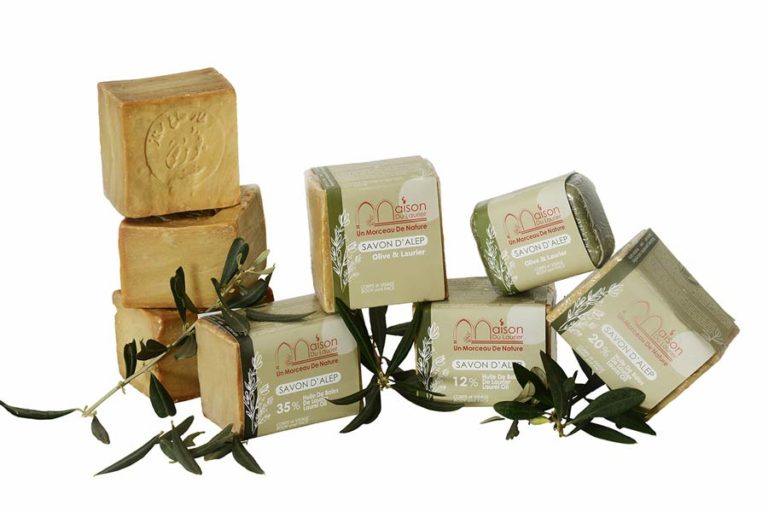
Aleppo soap is made from four ingredients: olive oil (as in Marseille soap), laurel berry oil, water, and natural soda. There are several types of Aleppo soap, distinguished by their laurel berry oil content. The higher the concentration, the more pronounced the cleansing effect. Commercially available products range from 3% to 35% for the most concentrated varieties.
Brownish-green in color, Aleppo soap keeps very well in a dry place, away from light. Again, be wary of the traceability of Aleppo soap. Many soaps contain palm oil or coconut oil instead of olive oil, so read the labels carefully!
Its benefits and how to use it
Aleppo soap is used for personal hygiene. Laurel berry oil gives this soap, hailing from the land of One Thousand and One Nights, a highly effective purifying action. Dermatologists recommend it for treating a variety of skin conditions, such as acne, eczema, and psoriasis. Aleppo soap can be used as a cosmetic product in its own right, for making face masks, or for washing the scalp.
In addition to its cosmetic properties, Aleppo soap is also an excellent moth repellent. Like Marseille soap, Aleppo soap is perfectly suited for household cleaning.
Pros and cons of each soap
| Ingredients | Feature | Benefits | |
| Marseille soap | Olive oil (or other vegetable oils) Water Sea salt Baking soda | Multi-purpose soap suitable for the whole family for personal hygiene Use as a household cleaner | Gentle on the skin, economical, versatile |
| Aleppo soap | Olive oil Bay leaf oil Natural soda Water | A specialized soap recommended for treating problem skin. Use as a household cleaner Natural moth repellent/td> | Natural treatments for skin conditions (acne; eczema) Comprehensive beauty treatments (face masks; hair washing and body care) Option to adjust the concentration of laurel berry oil depending on the desired result |
From the game
So, which one comes out on top in this showdown?
In reality, you can use both without any problem.
So, opt for Marseille soap if you have combination skin, if you’re looking for versatility, and if you’re on a tight budget.
If you want a soap that’s richer in terms of skincare benefits and you have skin issues, then look no further: Aleppo soap will meet all your needs!
Les derniers articles
Aleppo soap: Behind the scenes of its production
Aleppo soap: Behind the scenes of its production Aleppo soap may seem like a simple product because its list of ingredients is very short: olive[...]
Aleppo Soap: How Can You Tell the Real Thing from the Fake?
Aleppo soap: How can you tell the real thing from the fake? For several years now, Aleppo soap has been praised for its many benefits.[...]
Aleppo soap for household cleaning
Aleppo soap for household cleaning For several years now, laundry detergents have been criticized for their impact on health and the environment. In Europe, more[...]